chevre! feta! mozzarella!
Cheese, glorious, cheese… I now know how to make a few varieties!
My next party, of course, will feature house-made chevre… that’s how excited I am to show off what I learned. Speaking of learning, the most important tip I acquired in the 4-hour cheesemaking class was that temperature is one of the most important factors in successfully making cheese. Did you know that? I certainly did not!
It was wonderful to return to Love Apple Farm so soon after the Meyer Lemon class with Pim. With Dane and Tate on a boy scout camping trip, Paul en route from Germany and the dog visiting my parents, I was free on Saturday to take a 4-hour ‘Home Cheese Making’ class with fabulous Fiona, who makes AMAZING cheese from goat’s milk and cow’s milk. Being somewhat lactose intolerant, I was really excited that two of the three cheeses featured would be made from goat’s milk.
The class was packed with valuable information from start to finish. We learned cheesemaking basics (including what tools to buy) and Fiona’s techniques for successfully alchemizing milk into curds and whey. The most important thing: DO NOT mess with temperature – it will bite you in the ass! So, before I actually attempt my own chevre, I will be investing in a cheese thermometer among other things. Luckily, I already own a LeCreuset enamelware pot but I now need a really big one for double boiling. I’ll have to sweet talk Paul into that investment, of course…wish me luck! Note: you can only use stainless steel or enameled pots when making cheese, no aluminum or non-stick coated ones.
Making cheese (at least the types we made) is relatively easy. Essentially, you need to ‘ripen’ the milk and separate the curds and whey. After that, you typically drain the curds (in butter muslin or cheesecloth) and then brine or flavor the cheese… voila!
It really is that easy but I recommend taking a class as I did; otherwise, you run the risk of ruining a lot of expensive raw milk experimenting. Fiona let us see each stage up close and was able to troubleshoot situations on the fly. I’m not sure I would have been that cool under pressure (might have just tossed the lot down the drain instead of trying to bring it back to form).
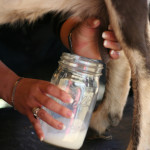
In the middle of the class, we got to milk Trixie, one of the retired dairy goats roaming the hillsides at Love Apple Farm. I was too busy behind the camera to try it myself but I got a great shot of one of my classmates. I love her perfectly manicured fingers, don’t you? Even us farm-wannabe folks can make cheese!
We ended the class with fresh mozzarella. I couldn’t believe how fast and easy the process was – can’t you just picture a pizza-making party where everyone creates the cheese from scratch? I’m bookmarking that idea for the future.
When I brought out the class-made chevre during yesterday’s lunch, Tate and Paul were quick to pounce on it. We all thought it was incredibly fresh and delicious.
Paul is taking a class next and we’re looking forward to more treats from Love Apple Farm. If you want to check out the course schedule, the website is at http://www.growbetterveggies.com/
My shots, in order, are:
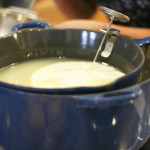
1) Fiona’s super cool technique for dispersing the mesophilic culture into the 86 degree F milk.
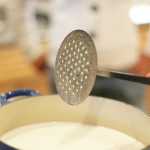
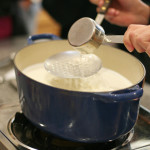
2) Checking that the milk ‘coats’ the spoon – a sign that the right things are happening!
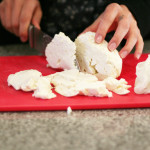
3) Fiona cutting the fresh feta so we could season and taste it.
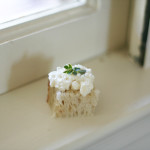
4) My feta taster (seasoned with grey sea salt and lemon thyme).
5) The iconic goat milking shot.
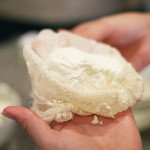
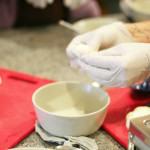
6) Fiona unwrapping the chevre after draining.
7) The dramatic effect of the mozzarella curds separating from the whey – this happened so fast!
8) Fiona demonstrates ‘stretching’ the warm mozzarella balls.
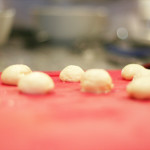
9) Mozzarella balls (bocconcini, in Italian) waiting to be salted and tasted.
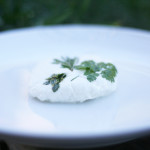
10) My chevre disk, seasoned with chervil, lemon thyme and rosemary