

book report: battle hymn/tiger mother
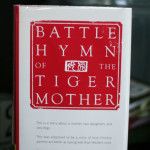
I had to hurry and finish this book yesterday because it was due back at the library today. I’m not unhappy to have rushed: no matter how you feel about the subject matter, it’s a fascinating look at someone else’s parenting style. At times I felt my blood pressure rising, other times I had tears in my eyes. Sometimes I felt pity for the author appearing to be so blindly convinced of her own superiority. As a parent, I do my best but don’t consider anything I do to be the “best” way. That said, however, I concede admiration for someone having so much conviction they perserve through the pain. And there ‘appears’ to be a lot of pain in the book. How much of this is true is unclear, especially after reading a few articles in the Wall Street Journal (responses to her book by other parents and her responses to the responses).
Am I really supposed to believe she meant it to be self-mocking and exaggerated certain episodes? I didn’t quite get that from my first read through. The book jacket declares it to be “unerringly honest, often hilarious, and always provocative story of one mother’s adventure in extreme parenting”. If she was unerringly honest, how can she be tongue-in-cheek at the same time? We who don’t know her personally cannot tell when she is joking or even being ironic. Personally, I didn’t find it hilarious. Fascinating, YES. Funny, no. How is touting the supremacy of one culture’s parenting methods over another funny? Isn’t there room for both?
And can we please stop competing? There are no medals for parenting. The most you can hope for is to foster/nuture cooperation, self motivation, understanding, tolerance and empathy. If your child can lead the world out of some of its current messes, that is a BONUS! However one chooses to parent, it is her/his business. I just hope we can all agree on some base level outcomes (cooperation, tolerance and empathy among them).
Somewhere between the author’s parenting ideas and other parenting ideas is BALANCE. The funny thing is, the concept of Yin and Yang is Eastern in origin. In interviews, Amy Chua has stated the book is about her journey from an extreme position to a more moderate one. But the transition seems to take place only in the final three chapters. We don’t get enough detail about her parenting style AFTER her daughter’s meltdown to make me feel a sense of balance in her story. It seems heavily weighted towards a ‘take no prisoners’ approach to parenting. That’s probably why it has created such a furor.
The most important thing to remember, however, is that this is a memoir, NOT a parenting guide. My feeling is, if you don’t like what’s she’s written, walk away knowing you won’t be following in her footsteps. Period. Then forget about it. I’ve already forgotten a lot of the book, which actually makes it a bit hard to write in a cogent manner today.
I’m sure this is going to cause a lot of commentary – and I do welcome your input – please weigh in below!
P.S. I want to mention my take away from reading this book (it took me a while to crystalize what I want to say). I’m very much a ‘lead by example’ type of parent. I believe in being authoritative but think it can be done with a “please” and a “thank you” thrown in. I don’t tolerate misbehavior of any sort and can say with reasonable certainty that my kids did not throw temper tantrums when they were little. I would have nipped any outbursts in the bud within seconds. Really. So I respect Amy Chua’s position that parents should be the decision makers and authority figures. It was a great reminder about what it means to be a parent. Authoritativeness is not popular with kids but I need to toughen up EVEN MORE as mine enter adolescence. Thank you, Tiger Mother, for reminding me who is Queen of the Jungle around here.
After commenting on your FB post the other day, I realized I’d never read Chua’s original article in the WSJ. So I looked it up…and could not read past the first few paragraphs. I had such a strong emotional reaction to what she had written. "Nothing is fun until you’re good at it"? How very sad to honestly believe that to be true! I cannot imagine being that type of parent, or being raised by one. Interestingly, from many stories I’ve heard I think my grandparents were at least partially "tiger parents" (as Zach pointed out to me, go to any little league or HS football game and you’ll see plenty of "tiger dads", it is clearly a parenting style that’s alive and well here in the western world as well). One infamous story I’ve heard told over & over was of my uncle who had his heart set on going to Rutgers law school, but my grandparents were against it- so they hid his acceptance letter and told him he didn’t get in. My mother and her siblings do hold great love & admiration towards their parents…but there is also, mixed with it, a bitter resentment born from the (even well-intentioned) hyper-controlling behavior.Interestingly, I am also now reading a book by Alfie Kohn which points out all the research showing why the super-controlling method of patenting is in many ways damaging and counter-productive. I feel sad for children raised this way.
Marcy, I felt the same way reading the article… at first. And I didn’t actually think I’d read the book, though it was recommended to me by several friends. But reading it from a mostly dispassionate perspective gave me the chance to take a fresh look at my own parenting style. We all feel that, "hey, at least I’m not as bad as she is…" when reading something as extreme and polarizing. But I did walk away feeling I can toughen up even more (and I think I’m pretty strict already) and my kids will be better for it, not worse. I keep going back to how I was raised: fairly strictly and with high expectations. I turned out to be very self-motivated, a hard worker, etc. Wanting the same for my kids makes me realize it’s OK to amp up the expectations as they get older (maybe even slightly higher than experts consider age appropriate). I don’t think it’s OK to live a pressure cooker, too many extracurriculars-at-once lifestyle, but I do think it’s alright to push my kids to excel from time to time. I see it as a subtle difference from my current MO, not a radical shift.